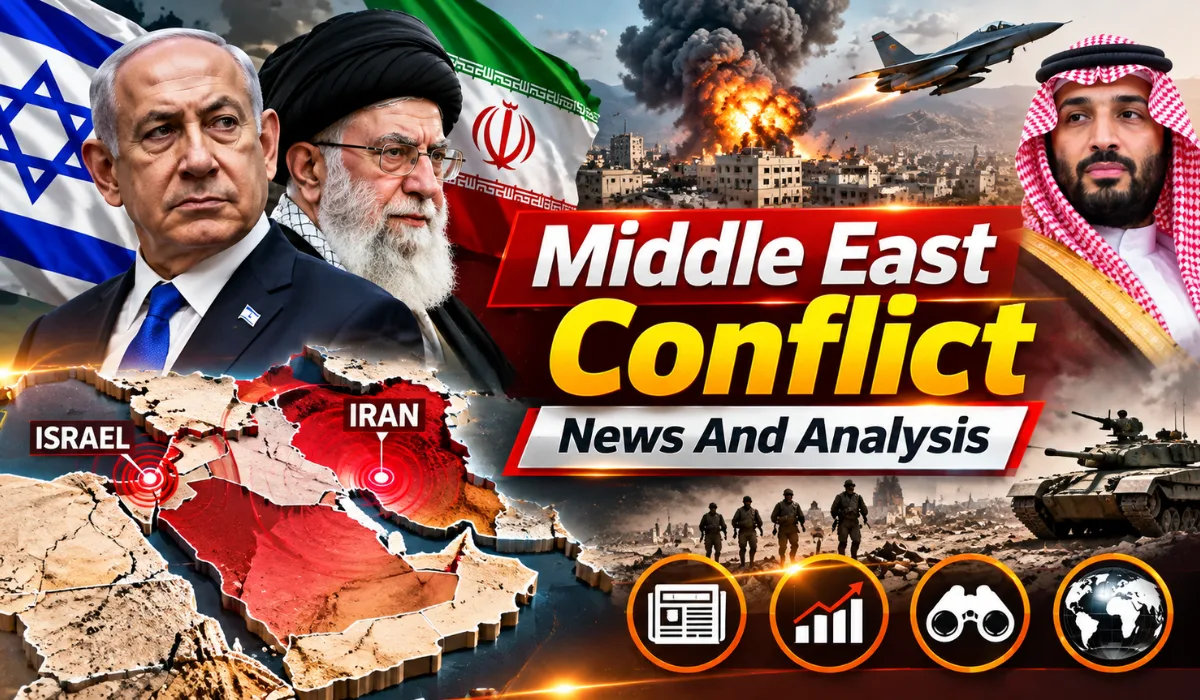
World headlines feel overwhelming when breaking alerts flash across every screen. One day brings news of naval blockades in narrow sea lanes, and the next day focuses on fragile peace talks in desert capitals. Understanding Middle East conflict news and analysis does not require a college degree in global politics. It simply takes clear facts, simple explanations, and a look at how events thousands of miles away connect to daily life everywhere. Events across this vital region have shifted dramatically throughout 2026. From major military confrontations in the Persian Gulf to historic political transitions in Damascus, every development carries massive weight for world markets and everyday families. This complete guide breaks down the latest Middle East conflict news and updates in plain, everyday language so any reader can follow the story with confidence.
What Are the Latest Middle East Conflict News Updates?
The Middle East conflict news and political analysis landscape in late 2026 centers on intense naval standoffs, renewed cross-border strikes, and stalled peace negotiations. After months of relative quiet during late summer, fighting flared back up across several fronts in autumn.
Breaking Middle East Conflict News and Analysis: The 2026 Persian Gulf Crisis
The biggest story dominating Middle East war news and international reactions involves the ongoing conflict between Iran, the United States, and Israel. Following joint military strikes launched in late February 2026, the region entered a prolonged period of air and sea clashes.
By November 2026, a two-month lull ended when Iranian forces launched multiple missile and drone strikes targeting American radar and military facilities in Bahrain, home to the U.S. Navy's 5th Fleet. In response, Washington expanded its naval presence by deploying a third aircraft carrier strike group, the USS Theodore Roosevelt, alongside existing warships to enforce an economic and naval blockade on Iranian oil shipments.
"The risk of renewed major war no longer depends solely on whether Washington decides to strike again. It also depends on whether leaders in Tehran conclude that the economic pain of a naval blockade is worse than the risk of military escalation." — Hamidreza Azizi, Senior Iran Analyst at the International Crisis Group
Read Also: Top Middle East Technology Industry Developments And Trends
Middle East Geopolitical Tensions and Security Updates Across Key Borders
Tensions are not limited to the Persian Gulf. Across the broader region, several flashpoints continue to test local armies and international diplomats:
- The Red Sea and Bab al-Mandab Strait: Yemen-based Houthi militants continue to threaten commercial shipping lanes, forcing global cargo ships to take long, expensive detours around Africa.
- Lebanon's Southern Border: Cross-border clashes between Israeli forces and Hezbollah fighters resumed in 2026, displacing hundreds of thousands of civilians and keeping border towns on high alert.
- Iraqi Security Zones: Iranian-backed militias in Iraq remain active around strategic areas like Jurf al-Sakhr, creating friction between local government leaders and armed groups.
Why Is the Middle East Important in Global Geopolitics?
To understand Middle East regional conflict analysis for readers, it helps to look at a world map. The Middle East sits right where three continents—Asia, Europe, and Africa—meet. Because of this location, almost every major trade route, energy pipeline, and international flight path crosses through or near this region.
Strategic Waterways and Global Trade Chokepoints
Geopolitics often comes down to geography. The Middle East controls three narrow ocean passages known as strategic maritime chokepoints:
- The Strait of Hormuz: Located between Oman and Iran, this narrow waterway carries roughly one-fifth of the world's petroleum supply.
- The Bab al-Mandab Strait: Positioned between Yemen and East Africa, this gate connects the Indian Ocean to the Red Sea.
- The Suez Canal: Found in Egypt, this man-made waterway lets ships travel directly between Europe and Asia without sailing all the way around Africa.
When military clashes threaten any of these waterways, ships stall, insurance costs skyrocket, and store shelves across North America, Europe, and Asia feel the delay.
Energy Reserves and Superpower Competition
Beyond shipping lanes, the region holds nearly half of the planet's proven crude oil and natural gas reserves. Major global powers—including the United States, China, Russia, and the European Union—all compete for influence here. The impact of Middle East conflicts on global politics is huge because every major nation relies on stable energy supplies to keep factories running, planes flying, and homes heated.
Top 10 Middle East Conflict News And Analysis Points to Watch
Keeping track of dozens of daily headlines gets confusing fast. These Top 10 Middle East Conflict News And Analysis developments sum up the most critical shifts shaping the region right now:
- U.S. Naval Buildup in the Gulf: Three American aircraft carrier groups now operate across regional waters to deter attacks and enforce sanctions.
- Strait of Hormuz Shipping Risks: Commercial tankers face record threats from drones and mines, requiring naval escorts to keep oil flowing.
- Bahrain Radar Strikes: Recent missile attacks on early-warning radar sites show a shift toward targeting defense networks rather than just symbols.
- Gaza's Winter Shelter Emergency: Despite earlier ceasefire agreements, nearly two million displaced people face freezing winter conditions without sturdy roofs.
- West Bank Displacement Surges: Rising settler violence and military operations continue to push Palestinian families from their homes at record rates.
- Syria's Fragile Political Transition: Following the fall of the Assad regime, interim President Ahmed al-Sharaa works to unify fractured provinces and armed groups.
- Kurdish Force Integration in Syria: Under a landmark 2026 deal, the Syrian Democratic Forces began merging into a single national military structure.
- Hezbollah-Israel Border Friction: Ongoing strikes in southern Lebanon prevent displaced villagers from returning home safely.
- Qatar and Egypt's Mediation Push: Gulf diplomats work around the clock to revive stalled truce talks before winter weather worsens conditions.
- Global Energy Transition Acceleration: High fuel prices push European and Asian nations to invest faster in solar, wind, and electric vehicles.
Israel Hamas Conflict Latest News and Analysis
The Israel Hamas conflict latest news and analysis reveals a complex reality where formal truce agreements clash with ongoing hardship on the ground. While an October 2025 ceasefire halted the heaviest full-scale bombardment in Gaza, true peace and recovery remain out of reach in late 2026.
Gaza Reconstruction Delays and Winter Challenges
United Nations officials warn that decades of human development in Gaza have been erased. Over 4,000 damaged buildings require partial or full demolition, while roughly 44,000 residents still shelter inside structurally unsafe concrete shells.
Humanitarian agencies report severe shortages of winter tents, spare parts, and heavy machinery. Strict Israeli restrictions on dual-use materials—items that could be used for both civilian rebuilding and military tunnels—continue to slow down basic repairs to water pipes, hospitals, and power grids.
West Bank Tensions and Diplomatic Deadlocks
At the same time, violence in the occupied West Bank has climbed sharply. International leaders, including UN Deputy Secretary-General Amina Mohammed, continue to call for a two-state solution that guarantees security for Israelis and dignity for Palestinians. However, deep political divisions inside Israel and leadership questions among Palestinian factions keep long-term political talks frozen.
Read Also: Middle East Smart City Development Projects: The Future of Urban Living
Middle East Conflict Impact on Global Oil Prices
Every time sirens sound in the Persian Gulf, drivers in Texas, Mumbai, and London watch gas pump prices climb. Understanding the Middle East conflict impact on global oil prices comes down to simple supply and demand.
How Oil Markets React to Regional Shocks
When the 2026 Iran conflict erupted in late February, international oil markets reacted almost instantly. On the first trading day of March 2026, benchmark crude oil traded near $71 per barrel. Within just four weeks, fears of a total blockade in the Strait of Hormuz pushed prices past $111 per barrel—a massive 57% jump in a single month.
| Timeline Period (2026) | Key Market Event | Crude Oil Price Trend |
| Early March 2026 | Outbreak of direct U.S.-Israel-Iran strikes | Surged from ~$71 to over $90 per barrel |
| April 2026 | Peak fears over Strait of Hormuz shipping closures | Reached highs above $111 per barrel |
| Summer 2026 | Temporary military lull and U.S. naval tanker escorts | Cooled down toward $85–$90 per barrel |
| November 2026 | Renewed Bahrain strikes balanced by weak global demand | Hovering near $93 per barrel despite weekly dips |
Why Fuel Costs Affect Groceries and Everyday Bills
Expensive oil does more than raise gasoline prices. Trucks need diesel fuel to haul vegetables to supermarkets. Cargo ships burn heavy fuel oil to carry electronics and clothing across oceans. Airlines raise ticket prices when jet fuel spikes. Because energy powers every step of manufacturing and shipping, global inflation rises whenever Middle East oil routes face danger.
"Oil markets do not wait for actual barrels to disappear from ships. Traders price in the fear of disruption the very second missiles launch near major sea lanes." — Francis Perrin, Senior Research Fellow at IRIS
Syria Conflict Updates and Political Developments
While global eyes often focus on the Persian Gulf, Syria conflict updates and political developments tell one of the most dramatic stories of the decade. After more than thirteen years of devastating civil war, the collapse of Bashar al-Assad's regime in December 2024 opened a brand-new, uncertain chapter for the country.
Life Under Syria's Transitional Government
Throughout 2025 and 2026, interim President Ahmed al-Sharaa and the transitional government in Damascus have worked to rebuild state institutions from scratch. In June 2026, a newly formed interim parliament met to draft laws, and public trials began against former regime officials accused of wartime abuses.
Despite political progress, serious security headaches remain:
- Kurdish Integration: Following clashes in January 2026, the Kurdish-led Syrian Democratic Forces signed an agreement to dissolve as a separate army and merge into Syria's national military, giving Damascus control over key border crossings and eastern oil fields.
- Protecting Minority Communities: Human rights monitors report ongoing sectarian friction affecting Alawite, Druze, and Christian communities, making national reconciliation an urgent priority.
- Remnants of ISIS: Small cells of the Islamic State still carry out hit-and-run attacks in desert provinces, requiring constant counterterrorism patrols.
Foreign Powers and Border Friction in Syria
Neighboring countries keep a close watch on Syria's recovery. Turkish troops maintain security zones along the northern border, while Israeli forces occasionally conduct raids in southwestern Syria to stop weapons shipments headed toward Lebanon. Meanwhile, international teams are working with Syrian engineers to clear millions of unexploded landmines left behind by years of war so farmers can safely plant crops again.
Middle East Ceasefire Negotiations and Peace Efforts
Behind the scenes of every military clash, teams of diplomats work tirelessly to prevent wider disasters. Middle East ceasefire negotiations and peace efforts rely heavily on regional mediators who can talk to all sides when rivals refuse to sit in the same room.
The Role of Gulf Mediators and International Envoys
Countries like Qatar, Oman, and Egypt serve as essential bridges in modern Middle East diplomacy. When direct communication breaks down between Washington, Tehran, Jerusalem, and militant factions, mediators pass messages back and forth in Doha and Cairo.
In November 2026, Qatari Foreign Ministry officials warned that continued strikes on Gulf bases threaten to derail delicate diplomatic channels. Mediators are currently pushing a step-by-step framework designed to lower temperatures before winter:
- Mutual De-escalation: Pausing missile strikes and naval blockades for a 60-day cooling-off window.
- Maritime Security Guarantees: Restoring safe commercial passage through both the Strait of Hormuz and the Red Sea.
- Humanitarian Corridors: Allowing unrestricted trucks carrying food, medicine, and winter shelter supplies into Gaza, Lebanon, and Syria.
Why Lasting Peace Remains Hard to Achieve
Peace deals often stall over trust and verification. One side demands an immediate end to economic sanctions before halting military pressure, while the other side demands verifiable security guarantees before lifting blockades. Until both sides see clear benefits from compromise, diplomatic breakthroughs remain fragile.
Read Also: Middle East Electricity Infrastructure News: Powering the Future
How Do Middle East Conflicts Affect Global Security?
Many readers wonder how do Middle East conflicts affect global security when fighting stays inside regional borders. In today's connected world, regional instability quickly ripples outward across continents.
Cyber Warfare, Drone Proliferation, and Military Budgets
Modern conflicts in the Middle East serve as testing grounds for new military technology. Low-cost armed drones, satellite-guided missiles, and electronic radar jamming used in regional clashes are studied by militaries worldwide. At the same time, state-backed cyber groups target power grids, shipping logistics, and banking systems far outside the war zone.
Furthermore, global superpowers must stretch their military resources thin. Deploying aircraft carriers, air-defense interceptors, and naval destroyers to the Persian Gulf and Red Sea leaves fewer defense assets available for Europe and the Indo-Pacific.
Middle East Refugee Crisis and Humanitarian Updates
Behind every political map and oil chart are millions of ordinary parents, children, and grandparents trying to survive. The Middle East refugee crisis and humanitarian updates for 2026 paint a sobering picture of human displacement.
Record Displacement Across Borders
According to United Nations refugee agency (UNHCR) tracking, over 31 million people across the broader Middle East and neighboring regions are forcibly displaced by conflict and instability. Escalating hostilities throughout 2026 forced hundreds of thousands more families to flee their neighborhoods:
- Iranian and Afghan Displacement: Over 636,000 people crossed from Iran into neighboring countries following the outbreak of hostilities in February 2026, adding pressure on border towns.
- Lebanese Families on the Move: Nearly 380,000 Lebanese citizens sought shelter across borders in Syria and beyond to escape southern border clashes.
- Gaza's Shelter Gap: Humanitarian agencies report that winter shelter funding in Gaza remains two-thirds short of the $283 million needed to protect families from rain and cold.
Aid workers emphasize that mental health support, clean water, and emergency schools for displaced children are just as vital as food parcels. Without steady international funding, host countries like Jordan, Lebanon, and Turkey struggle to keep clinics and classrooms open.
Frequently Asked Questions
What is the main cause of the current Middle East conflict in 2026?
The conflict stems from several overlapping disputes, including the February 2026 military escalation between the United States, Israel, and Iran over nuclear ambitions and regional influence, alongside unresolved tensions in Gaza, Lebanon, and Red Sea shipping routes.
How does the Middle East conflict affect everyday consumers?
Regional fighting threatens major oil shipping routes like the Strait of Hormuz, which pushes up global crude oil prices. Higher fuel costs make gasoline, airline tickets, shipping, and everyday groceries more expensive worldwide.
Which countries are leading peace talks in the Middle East?
Qatar, Egypt, and Oman act as the primary regional mediators. They work closely with United Nations envoys and diplomats from the United States and Europe to negotiate ceasefires and humanitarian aid corridors.
Is Syria peaceful now after the fall of the Assad regime?
Syria is moving through a fragile transition under an interim government led by President Ahmed al-Sharaa. While large-scale civil war battles have ended and Kurdish forces agreed to integrate into the national army, the country still faces economic hardship, landmines, and localized security threats.
What is the Strait of Hormuz and why is it in the news?
The Strait of Hormuz is a narrow sea passage between Oman and Iran. Roughly 20% of the world's petroleum passes through it on giant tanker ships, making any naval blockade or missile threat there a major concern for the global economy.