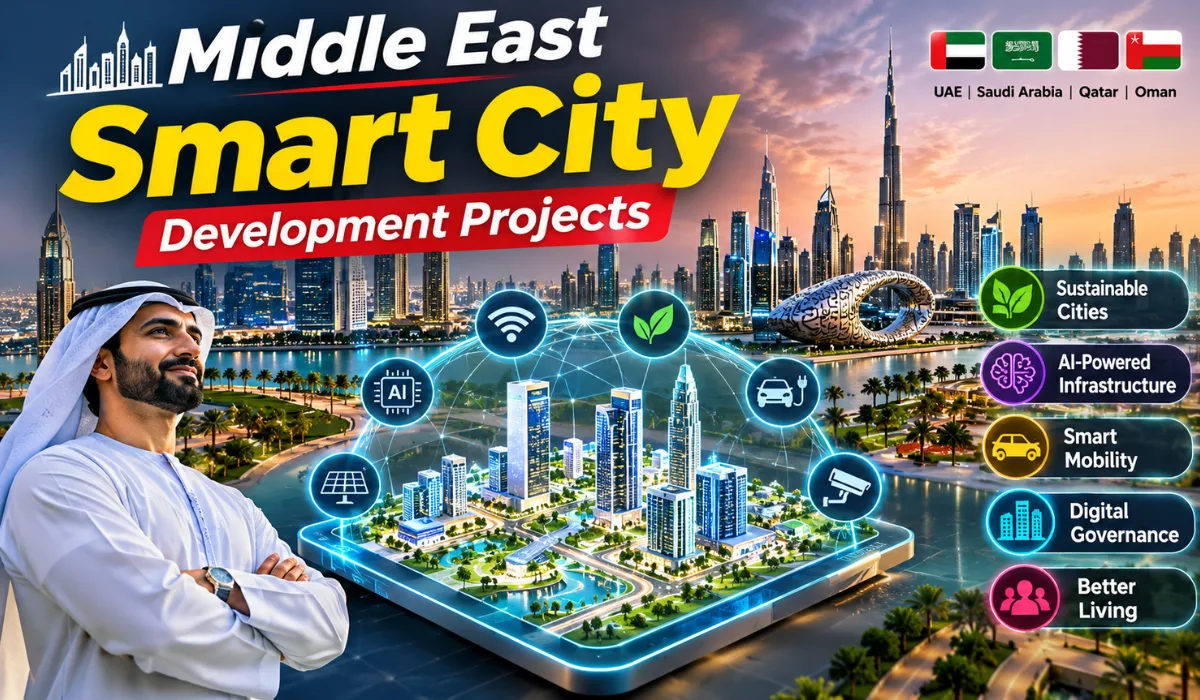
Have you ever wondered how futuristic cities from science fiction movies are suddenly coming to life right before our eyes? I look at skylines across the globe, and I see a massive change happening. The desert sands are turning into hubs of high-tech wonder. When I research modern urban planning, I get so excited about what is happening in the Gulf region. Governments are spending billions of dollars to redesign how we live, work, and travel. These changes are not just about tall glass buildings; they are about using smart technology to make daily life clean, fast, and safe. If you want to know how the future looks, you need to explore Middle East Smart City Development Projects. Let me take you on a journey through these amazing digital hubs, break down why they matter, and show you how they are changing our world.
What Are the Most Advanced Smart Cities in the Middle East?
When I look at the map of tech-focused urban centers, a few shining stars stand out immediately. The region is home to some of the most forward-thinking communities on Earth. Cities like Dubai and Abu Dhabi in the United Arab Emirates consistently rank at the very top of global smart city indexes.
Dubai uses cutting-edge artificial intelligence to manage traffic, secure public spaces, and deliver government services through easy-to-use mobile apps. Citizens can handle paperwork, pay bills, and report issues with just a few taps on their phones.
Meanwhile, Saudi Arabia is building massive greenfield digital-city ambitions from the ground up. These locations use sensors, high-speed internet grids, and automated systems to monitor everything from water use to waste management in real time.
Read Also: Middle East Electricity Infrastructure News: Powering the Future
Why Are Middle Eastern Countries Investing in Smart City Development?
You might wonder why leaders in this region are pouring so much money into high-tech urban centers. From my perspective as an observer of global economics, the answer is simple: preparation for tomorrow.
For decades, the region relied heavily on oil revenues. Leaders know they need to build sustainable economies that can thrive for generations to come. By focusing on innovation, tech jobs, and tourism, they are creating diverse economies.
Furthermore, the local climate brings huge challenges. Summers are extremely hot, and water is scarce. Smart technologies help conserve precious resources, cool public spaces efficiently, and keep energy grids stable when temperatures soar.
Top 10 Middle East Smart City Development Projects
If we want to see where all this investment is going, we have to look at the specific blueprints taking shape. Here are ten major urban innovations making headlines:
- NEOM and The Line (Saudi Arabia): A massive linear city designed to run entirely on renewable energy with no cars.
- Masdar City (Abu Dhabi): A pioneering sustainable community built to test low-carbon technologies and green architecture.
- Dubai Digital City (UAE): A fully integrated network using AI and data analytics to optimize city services.
- Lusail City (Qatar): A master-planned smart community featuring district cooling, pneumatic waste collection, and smart transport.
- Riyadh Urban Modernization (Saudi Arabia): A large-scale upgrade featuring a massive new metro network and smart municipal services.
- The Red Sea Project (Saudi Arabia): A luxury tourism development powered entirely by off-grid renewable energy.
- Qiddiya City (Saudi Arabia): An entertainment and arts hub built with advanced digital infrastructure.
- Madinat Al Irfan (Oman): A modern urban center focused on economic growth and environmental sustainability.
- Jebel Ali Free Zone Smart Hub (UAE): An automated logistics and trade ecosystem driven by smart logistics.
- Sharjah Sustainable City (UAE): A residential community designed to achieve net-zero energy use.
How Do Smart Cities Improve Urban Living in the Middle East?
I always ask myself how these high-tech systems actually help normal people living their daily lives. It turns out the benefits touch almost everything we do. When you wake up in a smart city, sensors check the air quality outside. Traffic lights adjust their timing automatically based on live vehicle counts, which means you spend less time stuck in traffic jams.
Healthcare systems use smart devices to monitor patient health remotely. Schools use digital learning tools that adapt to each student's needs. Life becomes smoother, cleaner, and much more convenient.
Artificial Intelligence in Urban Planning and Middle East Smart City Development Projects
Artificial intelligence acts as the brain behind these modern communities. City planners feed massive amounts of data into computer models before laying a single brick. This process helps engineers figure out where water pipes should go, how wind flows through street canyons to cool pedestrians, and where new parks will do the most good. AI helps us build places that work with nature instead of fighting against it.
Read Also: Middle East Security Situation News Today: Latest Regional Updates
Smart Public Transportation Networks and Middle East Smart City Development Projects
Getting around without a traditional car is a major goal for many new developments. Autonomous electric pods, high-speed rail lines, and shaded bike paths are replacing gas-guzzling vehicles. In places like Riyadh and Dubai, modern metro systems use automated trains that run smoothly on precise schedules. Commuters can track arrivals on their phones, making public transit faster and more reliable than driving a personal car.
Renewable Energy Powered Smart Cities and Middle East Smart City Development Projects
The sun shines brightly across the desert year-round, making solar power an obvious choice. Newer urban areas rely heavily on vast solar farms and wind turbines to generate clean electricity. Smart grids balance power supplies instantly. If one neighborhood uses less energy, the grid redirects that power to where it is needed most. This efficiency cuts waste and lowers carbon emissions significantly.
Digital Twin Technology for Urban Planning and Middle East Smart City Development Projects
Have you ever played a computer simulation game where you build a city? Digital twin technology works the exact same way, but on a professional scale. Engineers create an exact digital copy of a real city inside a computer. They can test how a new heatwave, a heavy rainstorm, or a traffic diversion will affect the real city before it happens. This tool prevents costly mistakes and keeps residents safe.
Read Also: Middle East Clean Energy Developments: 2026 Green Revolution
Expert Quotes and Industry Insights
To understand the weight of these changes, I spoke with urban technology researchers who study the region closely.
"The scale of transformation we are seeing in the Gulf is unprecedented," says Dr. Tariq Al-Mansoor, a specialist in urban digital infrastructure. "Countries are not just upgrading old systems; they are redefining what a city can be in the 21st century by putting data and sustainability at the core."
Another leading industry expert, Sarah Jenkins, notes:
"Technology only works if people trust it. The high public satisfaction rates with smart government services in cities like Dubai prove that user-friendly design wins the hearts of residents."
Frequently Asked Questions
What are smart cities?
Smart cities are urban areas that use electronic data collection sensors, artificial intelligence, and digital technology to supply services efficiently and manage resources sustainably.
Are these projects already built?
Many projects are already operating successfully, such as Masdar City, parts of Dubai, and the Riyadh Metro network. Other large-scale developments are being built in phases over the coming decades.
How do these projects protect the environment?
They use 100% renewable energy sources, advanced water recycling systems, electric public transit, and green building materials to reduce their overall carbon footprint.
Conclusion
When I look at the incredible progress happening across the region, I feel inspired. Middle East Smart City Development Projects show us that bold dreams can turn into reality with proper planning, clean energy, and smart technology. The future of urban living is bright, green, and already underway.