Australia is making big moves in the clean energy world. The country is famous for its sunny skies and windy coasts. Today, those natural gifts are turning into a massive economic superpower. Whether you are a business investor, a stock market enthusiast, or just curious about the planet, the latest updates from down under are highly significant. This deep-dive guide breaks down the most critical updates, policy shifts, and market movements reshaping the nation. Here is your comprehensive update on the Australia Green Energy Investment News landscape.
Why is Australia investing in green energy?
For many years, Australia relied heavily on coal and gas. However, a major shift is happening right now. The country faces a big challenge because it imports a large amount of its refined fuel. Recent global supply chain issues and international shipping disruptions proved that depending on foreign oil is a major risk.
By building up domestic power sources, the nation protects its own electricity supply and keeps energy costs stable for everyday families. Turning sunshine and wind into electricity means the country never has to worry about foreign fuel shortages again.
At the same time, the nation is looking toward massive economic opportunities. The world wants clean products. By investing in renewable power, Australia can create green industrial investment Australia hubs. These hubs will manufacture clean steel, refine critical minerals, and produce green fuels for export to countries like Japan and South Korea. It is a smart way to create thousands of local jobs while protecting the environment.
How much is Australia investing in clean energy?
The financial scale of this transition is historic. The federal government has committed a massive $22.7 billion to its signature "Future Made in Australia" program. This massive fund acts as the main engine for regional development and infrastructure upgrades.
Additionally, the Clean Energy Finance Corporation (CEFC) manages over $30 billion in concessional loans to kickstart private commercial projects. Combined with state-level funding and international private capital, total active investments across the nation now exceed $60 billion.
Read also: Australia AI Technology News: Latest Trends
Top 10 Australia Green Energy Investment News Updates
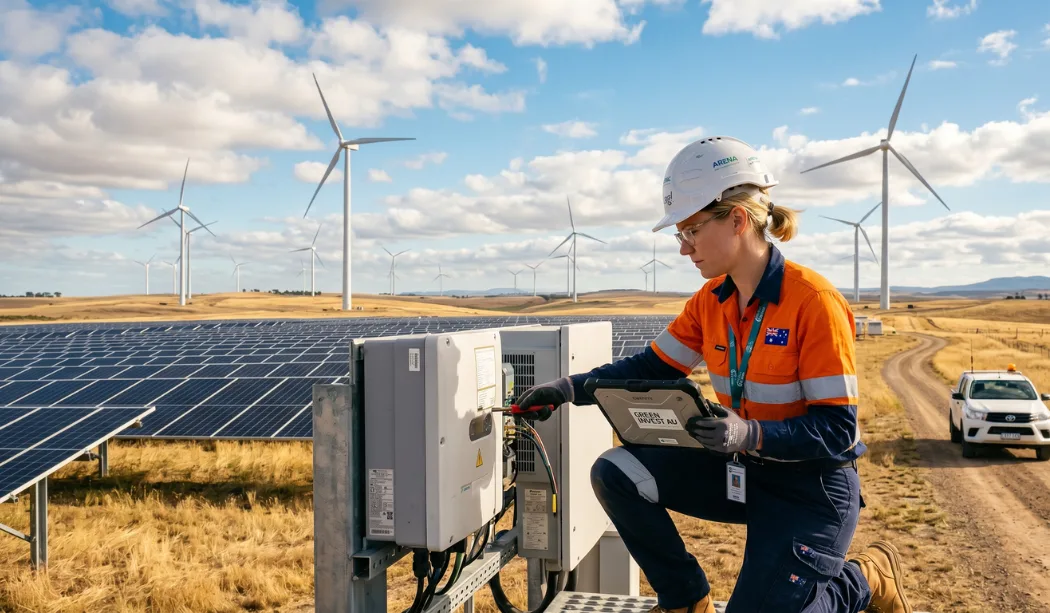
The clean tech market moves incredibly fast. To keep you ahead of the curve, here are the top ten most impactful headlines and structural updates dominating the market today:
1. The $22.7 Billion Future Made in Australia Act
This giant policy framework channels public money directly into massive infrastructure projects, industrial solar farms, and regional energy hubs to secure local supply chains.
2. Massive Tax Breaks for Foreign Investors
The federal government introduced a time-limited 50% capital gains tax discount for foreign investors who buy and sell eligible renewable energy assets. This policy aims to attract large-scale international infrastructure funds.
3. Giant Green Hydrogen Production Incentives
A targeted $14 billion funding package is now active specifically to lower the cost of manufacturing clean hydrogen gas using water and solar power.
4. The Western Green Energy Hub Digital Twin
Developers of the mammoth 70-gigawatt Western Green Energy Hub in the Nullarbor received new federal grants to build a complete computer simulation of their project, lowering future engineering construction costs.
5. Grid-Forming Battery Pipelines Reach 33 Gigawatts
Australia's pipeline for large-scale battery energy storage systems Australia projects has expanded rapidly to keep the main electricity grid stable without relying on old coal generators.
6. New Consumer Energy Resources Regulator Established
A new national technical regulator has been funded with $97.2 million to create unified safety and performance standards for household solar, electric vehicles, and home batteries.
7. Wholesale Electricity Market Modernization
The Australian Energy Regulator received fresh funding to reform wholesale electricity trading rules, making it easier for wind and solar farms to sell power profitably.
8. Massive Aluminium Smelter Clean Energy Transition
Up to $1 billion in public and private financing has been directed to transition heavy industrial sites, including the famous Boyne Island aluminium smelter, over to 100% renewable electricity.
9. Nationwide Solar Panel Recycling Pilot Launched
A new $24.7 million circular economy program is building 100 dedicated collection sites across the country to recycle old solar panels and recover valuable silver and silicon.
10. Heavy Transport Decarbonization Funding
New capital allocations from ARENA and the CEFC are funding shared ultra-fast charging hubs for electric freight trucks along major interstate highways.
What is the future of green hydrogen in Australia?
Green hydrogen is often called the fuel of the future. It is made by using clean electricity to split water into hydrogen and oxygen. Because Australia has vast open spaces and endless sunshine, it can produce this clean gas cheaper than almost anyone else.
The future looks incredibly bright thanks to the government’s $14 billion incentive program. The goal is to bring production costs down to under $2 per kilogram, making it competitive with fossil fuels. Large projects like the Australian Renewable Energy Hub in the Pilbara are moving ahead rapidly. These facilities will use wind and solar grids to create clean ammonia for global shipping and export markets.
Understanding the Clean Energy Policy Australia Investment Framework
To successfully deploy billions of dollars, a country needs clear rules. The current clean energy policy Australia investment framework focuses heavily on systemic stability and faster planning approvals. The government has allocated over $500 million to speed up and streamline environmental assessments for clean energy projects. This ensures that new wind farms and transmission lines can be built without years of bureaucratic delay, while still protecting local ecosystems.
Australia Renewable Energy Targets 2030
The nation is working under a strict legal mandate to reach 82% renewable electricity by the year 2030. This requires a massive, coordinated build-out of generation assets. To keep momentum high, the renewable energy policy Australia 2026 updates focus heavily on building the physical transmission wires needed to connect remote solar fields to major coastal cities.
Market Dynamics: Mergers, Stocks, and Climate Tech
The business side of the transition is seeing intense activity as traditional corporations look to buy into clean energy expertise.
Renewable Energy Mergers Australia
We are seeing a major wave of renewable energy mergers Australia transactions. Large international pension funds and local infrastructure conglomerates are buying up mid-sized wind and solar developers. These buyers want established project pipelines because getting new land approvals from scratch is becoming harder. Merging allows small developers with great local sites to access the massive capital pools of global investment giants.
Renewable Energy Stocks Australia News
On the Australian Securities Exchange (ASX), renewable energy stocks Australia news channels are focusing heavily on critical mineral miners and grid software companies. Companies that mine lithium, copper, and nickel are seeing high trading volumes. Additionally, utility companies that invest early in large-scale solar assets are outperforming traditional fossil-fuel-heavy competitors.
The Rise of Battery Energy Storage Systems Australia
Solar panels are amazing when the sun shines, and wind turbines work great during storms. But what happens at 9:00 PM when everyone turns on their air conditioners? That is where utility-scale energy storage comes in.
Development of battery energy storage systems Australia infrastructure is booming. The country now has a massive 33.2-gigawatt pipeline of big battery projects in various stages of planning and construction. These are not ordinary batteries; they use advanced grid-forming inverters. These smart systems can mimic the physical spinning weight of old coal plants, keeping the electrical grid perfectly stable even if a cloud suddenly covers a major solar farm.
Expert Perspectives on the Green Transition
Top energy analysts emphasize that Australia's shift has fundamentally evolved from an environmental initiative into an economic necessity.
"The global energy landscape has rewritten the rules of national economics. Australia's massive investments in grid-forming batteries and local green manufacturing are no longer just about lowering carbon emissions. They are about building structural self-reliance and creating a highly competitive, modern industrial economy." — Senior Energy Infrastructure Analyst
Frequently Asked Questions
How much is Australia investing in clean energy total?
Between public programs like the "Future Made in Australia" act, CEFC concessional loans, and private market capital, total active clean technology investments across the country exceed $60 billion.
Will Australia hit its 2030 renewable energy targets?
The country is on a very strong path to reach its target of 82% renewable electricity by 2030. Over 7 gigawatts of new large-scale green capacity were added last year alone, and the current project pipeline continues to expand.
Why are big batteries so important for Australia?
Because Australia is quickly closing its old coal-fired power stations, big battery storage systems are absolutely vital. They store excess solar power generated during the middle of the day and release it smoothly during peak evening hours, preventing blackouts and stabilizing prices.